

 |
|
Food Teachers Centre
January 2026 Newsletter
|
|
What it means for Food and Nutrition to be separate from D&T? (Part 1)
|
|
Hello
We hope this newsletter helps to bring you up to date on the curriculum review.
In our 2023 teachers survey Food education – fit for the future?
 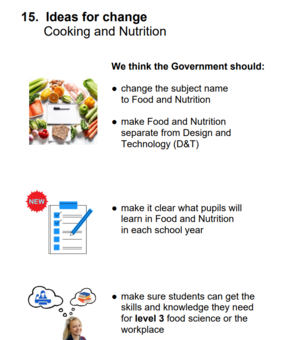 In the curriculum review report, Making Education Better for Everyone (Nov 2025), the DfE has responded to some of these concerns and is now in the process of drafting the new national curriculum (for all subjects) for England.
In the newsletters we will be exploring that this means for food teaching, and the latest update will be available at our Food Teacher day June 26th.
In this first newsletter of the year, we begin to explore what separating from D&T means for subject content and for teaching and assessing Food and Nutrition. Our next newsletter will look at what this means for teacher training, teacher recruitment and career progression.
Remember this is the start of the new curriculum journey, there are still a lot of unknowns! So, find out what is happening and be ready to contribute – we hope that this piece will make you think ahead of any government consultation.
What it means for Food and Nutrition to be separate from D&T? (Part 1)
At the last curriculum review (2014- the version we are working with now) for the first time ‘food’ had its own list of content and skills to be taught. Before this, it was always absorbed in generic language of D&T, such as ‘understanding materials’. However, the 2014 list of what to teach was short – only 2 bullets at KS2, 3 bullets at KS3 and 4 bullets at KS4!
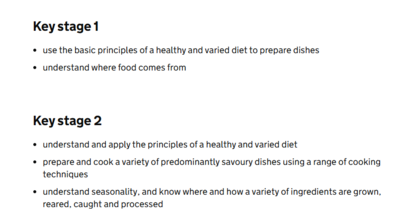 Nat Curr 2014 Encouraged by practising teachers responses in the consultation and matching the Dept for Education goal of ‘evolution not revolution’, the report says they will add more detail to the next programme of study. And it will be separate from D&T.
Making the legislation clear and more detailed has lots of advantages– the level and depth required should be more consistent across the country, strengthening entitlement and progression across the Key Stages, as it is taught every year. For word counting curriculum planners in schools, the same amount of detail in programmes of study for Food and D&T may help them understand there is more to the subject than cooking and it needs adequate time to be taught well.
 What will this detailed progression look like and what can we expect to see ?
We will have the wait for the next round of consultation to see this, but luckily, the curriculum drafters have much useful detail to build upon. Food teachers have access to other useful publications for the detail they needed in the past, for example Core Food Competences and Oak National Academy KS1-2 and KS3.
However, programmes of study are not simply lists of content to be taught as an entitlement for all young people, the national curriculum also has the task of exemplifying how young people “learn how to learn” in a subject. Whilst there is flexibility for schools, it’s easy to identify subject pedagogies that are important for each subject. We see this in English with the use of phonics, in Science by teaching the scientific method, and in History with inquiry-based learning, where students act as historians by investigating key questions, such as “Why did this event happen?”.
An important question for our community is to consider carefully what our future pedagogy, or disciplinary knowledge is?
What does it mean to think like a food and nutritionist? And what teaching and learning approaches will foster this?
In the future, when Food and Nutrition no longer has to adopt the learning and assessment approaches on D&T – designing, making evaluation – how should our subject be taught?
 Before food and textiles were placed into the Technology national curriculum in 1988, there were unique learning approaches within Home Economics (some of us will remember the Nuffield and Aquarian approaches). This approach was investigative and problem solving to address needs. Home Economics courses taught critical thinking skills by addressing practical, real-world challenges in areas like nutrition and resource management. For some of us, this became part of the D&T approach too.
But 40 years on – we should be very clear about the subject disciplinary knowledge, if it is no longer D&T.
Luckily, we can be informed by international work on Food literacy (United Nations) and their Global Action Plan, the Needs Assessment Tool and their School Based Nutrition Education White Paper. I was lucky enough to work with this team for several years.
GCSE subject criteria in 2016 also exemplifies what this may look like, as this new GCSE was no longer taught and assessed in the D&T suite of qualifications. The Food Preparation and Nutrition course described how students would demonstrate and apply skills when planning, preparing, cooking and presenting a selection of recipes, modifying recipes, or creating new recipes, to meet particular requirements. And that they would be able to:
 As we consider how the subject will be taught and share the departmental space with D&T, there is still much common ground. There are still some shared themes with D&T, for example:
For sure, our profession knows that there is more to this than following someone else’s recipe, cooking and eating. But it may not be as clear to a teacher without specialist training.
There is a big difference between cooking a recipe that you have been given, and understanding the function of the ingredients and processes enough to be able to adapt or create your own recipes to cook.
There is a big difference between eating/tasting for enjoyment, and a sensory analysis panel to optimise a great dish and make it even better.
There is a big difference between cooking simple dish, and side by side being allowed to evaluate that with a similar dish made by others (manufactured/restaurant dish) to critically compare what is in the dish, cost, nutritional value, time and quality.
In each of these examples the latter is more empowering.
 Potential issues?
What are the potential issues of Food and Nutrition programmes of study being separated from D&T?
Firstly, because this approach is new, it may be confusing for those teachers where food is not their specialist area and who may teach across multiple areas. Primary teachers often have thematic approaches and ask children to ‘design and make’ a dish to fit with that theme (themes such as a country, Teddy Bears picnic, or storybook character). Training and clarity will be crucial to explain how the two areas should be planned taught and assessed.
Secondly, there are some school leadership discussion and decisions that always impact on the way the subject is taught. This includes OFSTED and thematic reviews and how they portray best practice:
Thirdly, this separation can still be misunderstood, for example if D&T is placed in a ‘dominant’ position – Food and Nutrition may be seen as a discrete rather than equal. This can impact upon the timetabling and resourcing of the subject.
And it is probably still very confusing for parents and industry/employers to understand why they are grouped together.
Summary
For food teachers, this is probably the biggest change to our subject in many years, certainly in the last 10 years. Do engage with the discussions and let us know how this is being interpreted in your school – by your department, the senior leadership team and parents. The Food Teachers Centre team will support you throughout the process of change.
FOLLOWS IN NEXT MONTHS NEWSLETTER –
What this means for Food and Nutrition to be separate from D&T? (Part 2)
For teacher training, teacher recruitment and career progression
|
|
Who pay for the Ingredients?
|
 |
|
Who pays for ingredients?
In 2023, Louise Davies and I (Roy Ballam) developed a school resource to help tackle the increasing ‘cost of living’ and its impact in secondary school teaching food and nutrition.
The issue of effects the subject, especially where parents/carers are asked to provide ingredients or make a ‘donation’ towards the food – budgets are extremely tight. However, it is also a pressure on schools who supply ingredients as budgets will be stretched further for greater value – while maintaining education integrity and rigour.
The Key Stage 3 (KS3) resource included teacher CPD covering ingredient management, recipe principles, budgeting tips, ingredient provision models, and school policy considerations. It also featured 24 recipes, all in line with the curriculum, progression and building food skills, but importantly fully costed. We kept an eye on the pennies.
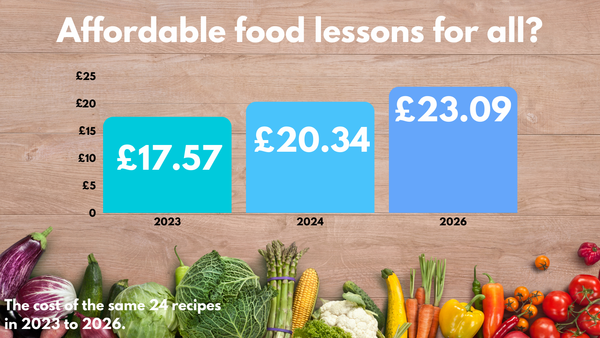
In 2023, the cost for one pupil to cook these 24 recipes over KS3 was £17.57.
Yesterday, I calculated the cost for the recipes again (same supermarkets).
In 2026, the same recipes now cost £23.09 per pupil – an increase of £5.52 or 31.4%.
Have school budgets have kept up with the rise in food costs?
There is a known post-code lottery for ingredient provision, as highlighted in the Ingredients for success? report launched in 2023.
The report listed several issues and recommendations, such as highlighting the hidden cost of food education, promoting exemptions in schools, and (importantly) campaigning for cost free food education.
With curriculum changes coming, there is a need for a national conversation about food education, ensuring that it is for all pupils and that cost is not a barrier.
Roy Ballam, Food Teachers Centre
Links
REPORT Ingredients for success?
RESOURCE and SUPPORT Affordable Food Lessons for All
 |
|
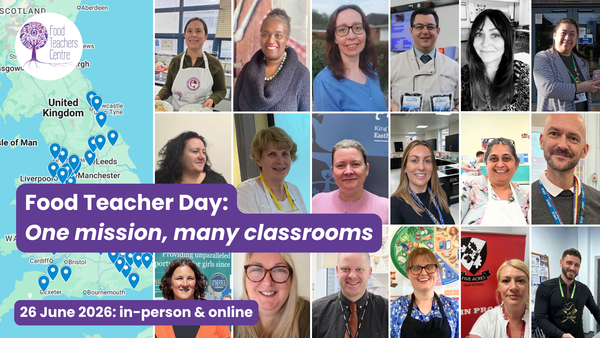
Food Teacher Day! Friday 26th June
Many Classrooms, One Mission
Our community national workshop -locally to you-
|
 SAVE THE DATE! BOOK YOUR CPD DAY NOW!
Let’s get together face to face
On Friday 26th June food teachers across the country will come together simultaneously in regional hubs. We will update you on the new National Curriculum, and give you a chance to adjust your scheme of work for next year, as well as great opportunities to share classroom tips and teaching issues. Come and join the fun!
BOOKINGS OPEN AT FEB HALF TERM
FOOD TEACHER DAY – ONE MISSION, MANY CLASSROOMS – 26th June 2026
60 venues across the country – simultaneous joining
DRAFT OUTLINE Programme
9:30 Welcome and scene setting, Louise
Session 1: Curriculum review impact (Have courage with your curriculum)
9:40 Presentations AND GROUP ACTIVITY :
Session 2: Looking beyond what we currently teach (e.g. contentious issues, or areas where the science is its infancy or debatable)
11:00 Presentations AND GROUP ACTIVITY :
Session 3: Tips and tricks of the food teacher (Action plan for positive food lessons)
12:30 Presentations AND GROUP ACTIVITY (action planning):
13:50 – 1400 Next steps – action plan
 |
|
Professional Development brochure and programme
|
 |


