November Newsletter

 
Food Teachers Centre
November 2025 Newsletter
Curriculum Review Report and Post 16 Consultation
Hello  
We know that this is a very busy time of year, so we are trying to help you all by summarising what it means for food teachers when examining the latest reports from Department for Education (England).
There are two areas to tell you about:
 
1. Post 16 – Level 3 
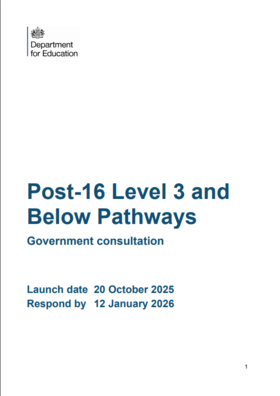
There is a consultation until January 12th 2026. As you know we do not have much choice of Level 3 qualifications since the T level development was withdrawn, and removal of our 2 ‘A’ levels in 2016. We know that this has impacted upon our subject negatively and the talent pipeline does not have a clear progression route anymore.  With the vast number of employment areas in the food industry this has led to a skills shortage at all leves, including technical and professional.
Recently, the government opened a consultation on a NEW POST 16 qualification ‘V’ Level.  This may provide a vocational route for students who wish to continue to study food in schools, but our subject is very wide and offers a great many opportunities, thus more than one route may be needed L2 and 3.


“The Department for Education (DfE) is seeking feedback on the planned design and implementation of the new pathways for 16 to 19-year-olds announced in the Post-16 Education and Skills Strategy, including:
  • A third, vocational pathway at level 3: creating  V Level qualifications. V Levels will sit alongside A levels and T Levels and will offer a vocational alternative to these academic and technical routes.
  • Two new pathways at level 2: simplifying the current offer and providing a clear line of sight to both further study at level 3 and skilled employment through the Further Study pathway and Occupational pathway.”


For food teachers – the consultation asks many general questions (21 questions!), but we encourage you to make your voice heard and answer the key relevant questions – If you are short of time FOCUS on Questions 3, 5 and 17.  This will not take long and we provide a simple guide to help you understand the process here.


3. Which subject areas do you think are most appropriate for delivery through V Levels? Please provide evidence of relevance to employment sectors or further study.


5. What factors should we consider when creating T Levels where there are currently no level 3 occupational standards? Please explain your answer.
 17. What non-qualification activities do you think are successful at supporting vocational students to engage best in their course content in order to achieve in their course and progress to their stated destination?


PLEASE RESPOND BY 12th JAN
If you have time to answer all questions – here is our full GUIDE.
 
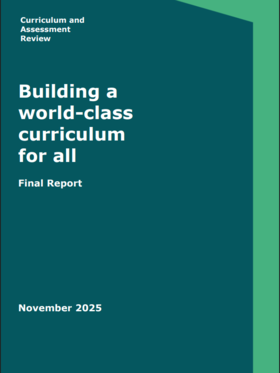
2. Curriculum and Assessment Review (CAR) published Nov 2025
‘All the subjects in the national curriculum are valuable and play an important role in preparing young children for life and work’.  
CAR Final Report
What this means for food teaching?
Academies and the National
Curriculum
For academies, although their
curriculum must be ‘broad and balanced’, they do not currently have to follow
the national curriculum. However, the Government’s Children’s Wellbeing and
Schools Bill contains a provision to require academies to teach the national
curriculum.
See page 19.
This indicates that food and
nutrition education will be compulsory in all schools, including academies.
This means more food teachers (including training for food teachers) and food
rooms.
We need to monitor the separate
bill going through parliament.
Curriculum Principles
recommendations
Foundation subject content
should specify the essential substantive knowledge and skills which should be
taught to enable children and young people to meet expectations at the end of
each key stage.
• The refreshed national
curriculum should ensure the professional autonomy of teachers is maintained
,
making sure that greater specificity does not substantially restrict
teachers’ flexibility to choose lesson content and how to teach it.
• The national curriculum
is for all our children and young people.
As such, it should reflect our diverse
society
and the contributions of people of all backgrounds to our
knowledge and culture. Develops a programme of work to provide evidence-led
guidance on curriculum and pedagogical adaptation (as well as
exemplification) for children and young people with SEND, including those in
specialist provision, who experience various barriers to
accessing the curriculum.
• Involves teachers in the
testing and design of Programmes of Study as part of the drafting process
.
This must take into consideration the curriculum time that is available,
ensuring the national curriculum is ambitious but teachable within a typical
school timetable.
See page 180.
You are the food professional. CPD
will be essential. New Schemes of Work, with lesson plans, will need to be
created (amended).
Diversity is a key part of the
curriculum.
Get involved in this review and
have your voice. Sign-up for email alerts here.


Cooking and Nutrition
recommendations
We recommend that the
Government:
• Renames the subject ‘Food
and Nutrition’ and ensures it has its own aims and purpose of study that
better reflect what it covers and its discrete identity within D&T.
• Ensures that sufficient
detail in the curriculum sets clear expectations about what should be taught
at each key stage to reflect the fact that the subject develops skills for
life as well as progression to further study.
• Reviews the level 3
vocational options for food science to determine the best means of ensuring
that the needs of learners are met and that there is a strong ‘pipeline’ into
higher education and careers.
See page 70.
Name change, with own aims and purpose, although still within D&T.
 
More detail about what to teach to be provided. Details yet unknown.
We should remind the government that language such as becoming a ‘topic’ in primary D&T or a ‘discrete’ part of D&T, is inappropriate if the curriculum sets out more detail to be taught.  It should encourage strengthening rather than further marginalisation of this crucial subject.

Encouraging that post-16 is being reviewed for food. Ensure you have your say before 12th Jan.

Accountability recommendations
We recommend that the
Government:
• Removes the EBacc
performance measures and the associated EBacc entry and attainment headline
accountability measures.
• Retains Progress 8 (and Attainment 8) with no changes to its structure or subject composition
but renames the current EBacc bucket to ‘Academic Breadth’ bucket.
• Continues to develop
initiatives related to similar schools, with a particular emphasis on
supporting inclusive approaches within accountability measures.
Page 191.
Remove EBacc performance measures and rename the EBacc bucket to ‘Academic Breadth’ while retaining Progress 8 and Attainment 8.
Please see the next section regarding new proposed buckets.
 

Food teachers can be proactive, promoting their subject ready to be included.

Key Stage 4
Volume of assessment
We recommend that the
Government:
• Works with Ofqual, seeking
to reduce overall exam time by at least 10%
, focusing on assessment
design choices to deliver this reduction, and going further than this where
possible. This should be considered on a subject-by-subject basis, ensuring
minimal impact on reliability, fairness and teaching and learning.
• Works with Ofqual to
introduce a design principle that considers of the volume of exam assessment
as a priority. The DfE and Ofqual should explore a range of options within
each subject to seek to minimise exam length whilst ensuring minimal negative
impact on reliability, fairness, teaching and learning and system
resilience.
• Ensures that, in
implementing the above recommendations, each subject retains at least two
assessment components.
See page 192.
This is generic advice for all
GCSEs, not just ‘food’.


Non-qualification activity
recommendations
We recommend that the
Government:
• Strengthens guidance for
16-19 study programmes to promote effective practice in delivering
non-qualification activity and to clarify expectations about the types of
activities that should be core to the enrichment offer. The focus should be
on applied knowledge and transferable skills that will enable learners to
step confidently into adulthood.
• Considers whether certain
elements of non-qualification activity should be made mandatory so that
learners’ access to opportunities is more consistent.
See page 196.
Potentially, this could take the
form of food life skill type sessions at post-16.
What happens next?
  • We’re developing the new
    curriculum with teachers, curriculum experts, pupils and parents.
  • The final curriculum will be
    published in spring 2027, and schools will start teaching it from September
    2028.
 

More information

Ensure you take part – make sure
your voice is heard.
Progress 8 and Attainment 8 – an explanation of the proposed improved model
DfE
and other CAR documents
What
this means for food teaching?
What’s
changing?
 
Reflecting
the importance of a curriculum that supports high standards, we will develop
and consult on an improved version of Progress 8 and Attainment 8 that
balances a strong academic core with breadth and student choice.
  • The government will consult in due course.
  • We will publish our response in the summer term 2026 so that schools can take the revised measure into account when determining
    subject choices for pupils who will start their GCSEs in September
    2027.
(Progress
8 and Attainment 8 explanation, page 3)
The
Food Teachers Centre is concerned that about these changes for GCSE Food
preparation and nutrition.
Potentially,
GCSE ‘food’ numbers could decline dramatically.
We
will monitor the situation and engage in the government’s consultation,
representing the food teacher voice.
We
strongly recommend that you play an active role in the consultation process.
Get
involved in this review and have your voice. Sign-up for email alerts here.
What
will it look like?
Progress
8 and Attainment 8 will continue to be based on a calculation of pupils’
performance across eight qualifications.
The
number of qualifications each pupil should enter remains a professional
judgement for schools led by what best meets the needs of an individual.
Where more than eight subjects approved to count in performance tables are
taken, the Progress 8 and Attainment 8 score for t e pupil will be determined
by assigning points to the pupils’ highest grades in each slot.
 
There
will be 8 slots:
  • Slot 1- English
  • Slot 2 – Maths
  • Slots 3&4 – Science
  • Slots 5&6 – Breadth (two from humanities, creative
    and/or languages)
  • Slots 7&8 – Breadth (Food preparation and nutrition
    is mentioned here – page 9)
 
Slots
7 & 8
These
two slots will take the two highest point scores in any two other subjects,
including English language or literature (if not counted in the English
slot), other GCSE qualifications (including those eligible for Slots 3, 4, 5
and 6), or any technical awards from the Department for Education (DfE)
approved list.
 
GCSE
Food preparation and nutrition is within slots 7 and 8. (Progress 8 and
Attainment 8 explanation, page 9)
Food GCSE and H&C vocational courses are hugely popular at KS4 and are often over-subscribed in current options.
 
Whilst retained within D&T at KS3 and not being allowed as stand-alone subject, the government position changes in KS4, and Food is not considered as a science or a creative subject (alongside D&T).
Unfortunately, it is suggested that ‘Food’ appears in Slots 7 & 8 (breadth), which also includes many other GCSE subjects and vocational (technical) awards. It could also include English Language/Literature GCSE, as well as any subjects in slots 3, 4, 5 and 6.
Our concern is that GCSE Food could become marginalised, dramatically affecting uptake if in Slots 7&8.
We also question why ‘food’ was not in Slots 5 & 6, under Category B (creative), which include subjects with ‘practical’ aspects. We suggest the renaming of the grouping to ‘creative and practical’ as a unifying feature of the grouping.
We would like to better understand the rationale for the current proposal. It appears that in trying to address the decline of D&T and some creative subjects uptake, that Food is being placed in a grouping that will marginalise the subject and reduce the number of students able to access GCSE and vocational awards dramatically.

Get involved in this review and have your voice. Sign-up for email alerts here.

Consultation
We
will consult on Progress 8 options to ensure that pupils can access a strong
academic core and a breadth of subjects, including creative subjects. Working
with the Office of Qualifications and Examinations Regulation (Ofqual), we
will ensure we retain the rigour of exams whilst reducing the amount of time
pupils spend in GCSE exams by 2.5-3 hours on average. (CAR, page 10)
Reflecting
the importance of a curriculum that supports high standards, we will develop
and consult on an improved version of Progress 8 and Attainment 8 that
balances a strong academic core with breadth and student choice.
It
is essential that all students retain this academic core, but we believe the
current structure has hampered progress in subjects which strengthen our
economy and society including the arts, and therefore should make changes
which recognise the value of these subjects and the importance of a broad
pre-16 curriculum. Improvements to Progress 8 and Attainment 8 will take
effect after consultation.
(CAR,
page 45)
There
will be an opportunity for you to have your say.
Ensure
that you register for DfE emails.
Get
involved in this review and have your voice. Sign-up for email alerts here.
Timeline
 
The
government will consult in due course
. We will publish our response in the
summer term 2026
so that schools can take the revised measure into
account when determining subject choices for pupils who will start their
GCSEs in September 2027.
(Progress 8 and Attainment 8 explanation, page
3)
The
exact timeline for the Progress 8 and Attainment 8 consultation is unknown.
The
Food Teachers Centre will inform the community of timelines and ways to
engage in the consultation when known.
Save the date      Friday 26th June
SAVE THE DATE! BOOK YOUR CPD DAY NOW!
Let’s get together face to face – at last!
The Food Teachers Centre is coordinating a major national summer event on Friday 26th June, where food teachers across the country will come together simultaneously in regional hubs.  When we were planning this summer’s event, we wanted to bring you something more personal, more local, more fun than an on-line day. After all, so many food teachers are on their own – its much better to have time to talk with colleagues and share what’s happening and help each other.
So, next summer we will hold a national event – but NOT JUST ON LINE!  You can join IN PERSON and be with a group of local teachers!
We will update you on the new National Curriculum, and give you a chance to adjust your scheme of work for next year, as well as great opportunities to share classroom tips and teaching issues.  Come and join the fun!
We already have hosts in London, Essex, Newcastle, Taunton and many more will be announced in the new year.
Would your school like to host our event?
If you meet the requirements below email us and we will get in touch
info@foodteachers centre.co.uk
NOTE: – we will only have one host school in each region/area
Host School Requirements:
  • A suitable conference/meeting or food room available all day (Fri 26th June)
  • Minimum seating capacity of 20
  • Projection facilities and strong internet connectivity suitable for video streaming to/from New Row
  • SLT approval for free use of the room (host school receives a free place and valuable regional visibility)
  • Ideally more than one staff member available, e.g., a technician/staff)
  • Confidence in joining and supporting online meetings
  • Ability to provide refreshments; onsite lunch option is helpful (canteen or teachers bringing their own lunch)
  • No anticipated OFSTED visit on or near the date
  • Useful parking capacity and essential good transport links
  • At least 10 secondary schools within approximately a 40-minute radius
The Food Teachers Centre team will run the live presentations and manage the bookings and all the behind the scenes.
What hosting involves:
  1. Welcoming attendees and supporting introductions
  2. Helping organise groups and keeping the day running to time
  3. Providing refreshments
  4. Completing a tech check
  5. Joining a hosts WhatsApp group for the day
Facebook Guides to save you time!
The Food Teachers Centre Facebook Community is an invaluable source of great advice and resources to save you a lot of time.
Two of the best places to look for what you need are: FEATURED and GUIDES.
Here we have stoted the most useful things in way that is easy to navigate. Its all FREE!
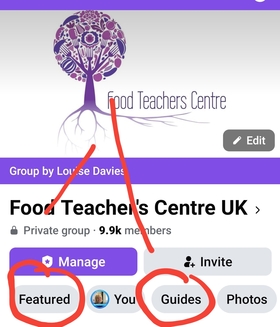
     
Food Teachers Centre has 37 Guides, each has many useful resources and files stored within, which have been shared by the teaching community. In this newsletter I will focus on just three of them.
Guide 12 – Ideas for planning Open Evenings
Within the next couple of months, we will be planning for Option Evening. Setting up our “stalls” to encourage students to take our subject at KS4. Within this guide you will find examples of resources and video clips to help you.
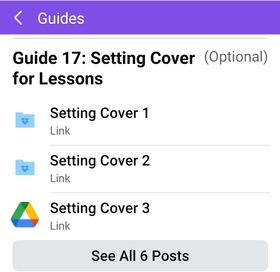
    
Guide 17 – Setting Cover
We all know that towards the end of term some may need to take time off due to illness. Get ahead now and download some easy to use cover sheets which you can have ready to send in as and when required
Guide 16 – Festive Fare
Yes, not long now till someone will be asking for Xmas recipes, quizzes etc. Pop along to Guide 16 where you will find lots of shared recipes and ideas for end of term activities.
Click on the image above to take you to each GUIDE, or follow the facbook menu in the group.
Do get in touch on Facebook if you have any questions
Jill Oliver
Food Teachers Centre 2025-26
Tunnock’s Teacake Challenge 
The Tunnock’s Teacake Challenge, now in its 8th year is live for 2026 with the theme “Around the World in a Bite”

 
All the resources to help you deliver the challenge can be found in the Guides section of the Food Teachers Centre Tunnock’s Teacake Closed Facebook Competition Group.
This challenge is only available if you are a Food Teachers Centre member): For resources to run the challenge CLICK HERE and on the Google drive: CLICK HERE
Use the challenge to teach presentation skills to your students and reward them at the same time by downloading certificates of particopation and school winners: CLICK HERE
Enter your best students work into the national competition for a chance to win a prize awarded by Tunnock’s themselves.
There are three categories:
  • Over 14 years
  • Under 14 years
  • Most novel
There will be one winner from each category plus an overall challenge winner. Find out how to enter: CLICK HERE
All entries are published in a fabulous book produced each year once the results have been announced. To purchase a copy of last year’s book: CLICK HERE
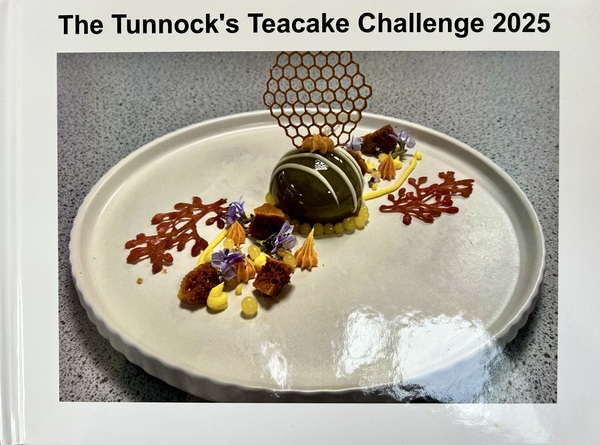
Excellent for a no bake end of term activity or 1st lesson back after a break. Why not plan it into your scheme of work? 
Closing date 1st June 2026
Already completed the challenge? Don’t delay, enter today on the Food Teachers Centre Tunnock’s Teacake Closed Facebook Competition Group: CLICK HERE (This group is only available if you are a Food Teachers Centre member)
Good Luck and Have Fun!
Do get in touch on Facebook if you have any questions
Adrienne Gristwood and Suzanne Gray
Calling all school in Wales
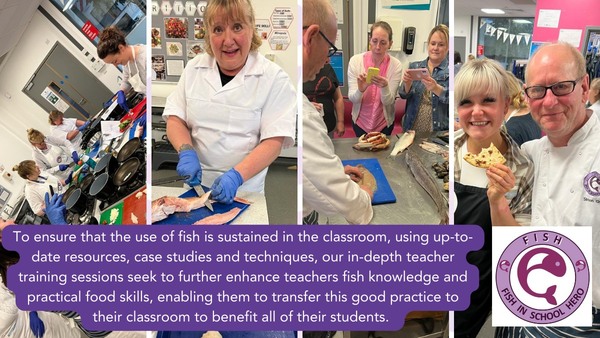
Great news!  – we are now able to extend our FISH HERO programme to every school in Wales that would like to join.  This is fully funded.
In 2026, we would like to recuit all secondary schools in Wales, we will be inviting you to FREE teacher training (both on-line and face to face workshops), offering you FREE student masterclasses to develop confidence and skills. Once you are trained, we will be offering you FREE fish to use on your lessons.
We are looking for schools willing to host teacher training for neighbouring schools in the following locations:
  • South Wales – Cardiff, Swansea, Haverford West
  • North Wales – Wrexham, Bangor
  • Mid Wales – Newtown, Merthyr
MORE INFORMATION and Sign up TODAY! Don’t miss out in 2026
 
Upcoming events!
‘Spotlights’ in the Food Teachers Centre Community group
SPOTLIGHT:  Sheffield Food Tours            Thursday 13th Nov at 7pm
Meet Sophie Barber, founder of Sheffield Food Tours. Sophie shares her current offer of food tours for schools and how she would like to develop her ideas for the future.
SPOTLIGHT: CLEAPPS – Health & Safety Refresher   Thursday 6th Nov at 7pm
DT Specialist, Dave Parry for CLEAPPS, answers the most commonly asked H&S questions for Food teachers
Thu, Nov 27 at 7 PM

Join Ant Fleming, WJEC Regional support team for Food and myself. Where he introduces the new spec:
WJEC L3 Alternative Academic Qual in Food Science and Nutrition. (The new spec)
Thurs 8th Jan 2026 at 7 PM
Join Ant Fleming, WJEC Regional support team for Food and myself. Where he answers our questions on the new spec:
WJEC L3 Alternative Academic Qual in Food Science and Nutrition.
 
SPOTLIGHT: FAFOL: Recipe support packs.  Thurs Nov 27 at 7 PM
Join Frances Meek where she explains the recipe support packs that are available on Food A Fact of Life website (FAFOL).
SPOTLIGHT: FAFOL: Sustainability Resources Thurs 11th Dec at 7pm
Join Frances Meek where we explore the sustainability resources on offer on Food A Fact of Life website (FAFOL).
SPOTLIGHT: FAFOL: Support for pupils with additional needs Thurs 15th Jan 2026 at 7pm
Join Frances Meek where we explore the support for pupils with additional needs available on Food A Fact of Life website (FAFOL).
Join Frances Meek where we explore the resources available on Food A Fact of Life website (FAFOL), looking at the science through the context of food.
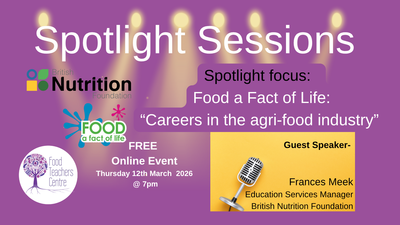
SPOTLIGHT: FAFOL: Careers in the agri-food industry  Thurs 12th March at 7pm
Join Frances Meek where we explore the careers in the agri-food industry.
Oak National Academy – (on-line workshops)
A new Cooking and nutrition curriculum for National Curriculum Key Stages 1 to 3.


Date Training
9th
Dec 
 
Designing a modern food curriculum with Oak as your foundation
20th
Jan 
 
Inclusive food education: Adapting Oak for learners with additional needs
3rd
Feb 
Empowering pupils: Using Oak for independent and home learning


All at 7pm


The British Nutrition Foundation is grateful for the financial support from the All Saints Educational Trust to support the dissemination and training.
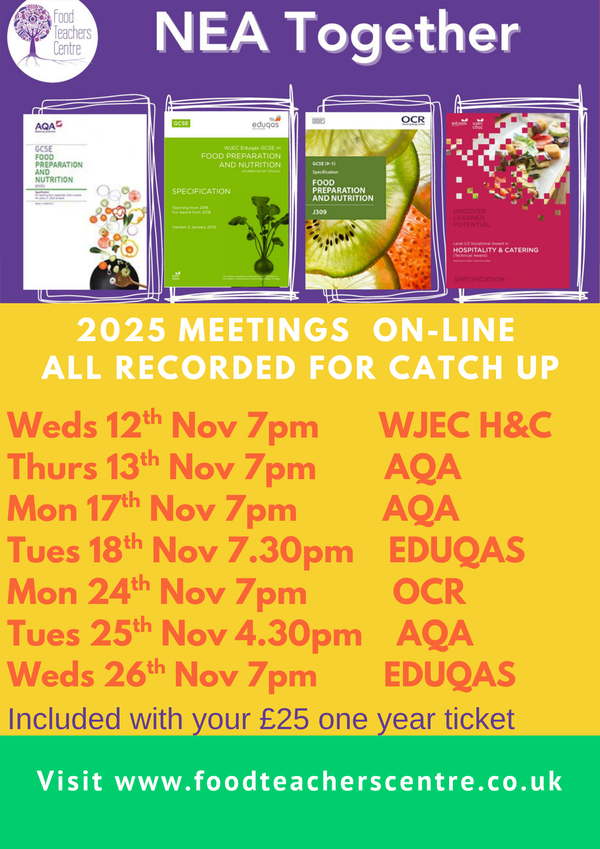


This course includes being able to join us for NEA Together support meetings.
 
BOOK HERE – and more details


Teaching KS3 for the first time?
 
CRAWLEY, West Sussex 27th Nov
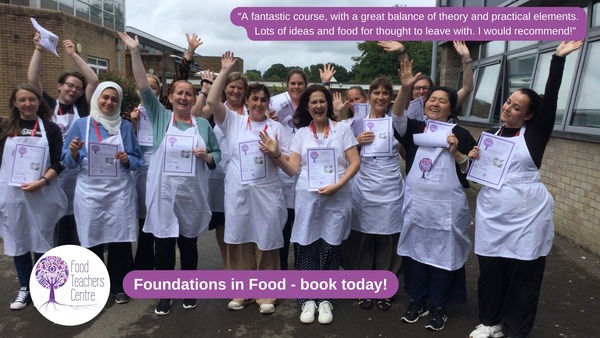
Foundations in Food has been designed to support non specialist and new teachers who are teaching food at KS3. It will give teachers the opportunity to look at the pedagogy of teaching food and cover the practical requirements which will help 60 minute practical sessions run smoothly.
Focusing on Basic Nutrition, Health and Safety, setting up demonstrations and tips on how to set up the practical classroom. The practical aspect of the day will consist of a hands-on approach, covering key practical skills required at KS3 and provide ready to use resources to take away.
Training outcomes By the end of this session, you will be able to:
  • Describe
    the requirements of the KS3 (11–14-year-old learners) D&T curriculum
  • Explain
    and demonstrate a wide variety of practical skills.
  • Identify
    and explain the links to nutrition, food safety, food science, food
    choice, and food provenance through carrying out practical sessions.
“The course has given me the confidence I needed to carryout practical food lessons”
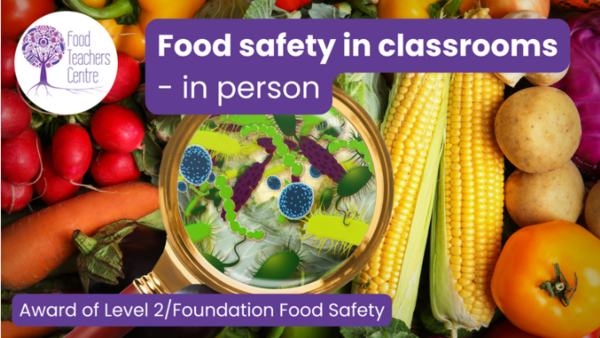
Food Safety accreditation  in person workshops BOOK HERE
28th Nov CRAWLEY, West Sussex
  • Award and certification for Level 2/Foundation Food Safety recommended renewal every 3 years.
  • Accreditation for the national recognised framework for food teaching standards SECTION 9.1 to 9.6 . Implementing good food safety and hygiene Food teaching in secondary schools: A framework of knowledge and skills
 
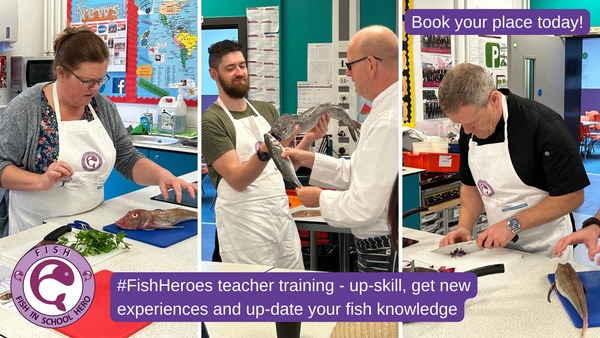
Fish Hero programme face to face Teacher practical workshops   FREE
 
Courses are usually on Saturdays around the country.Great if you are completely new to handling fish – we help you with your knife skills, cooking dishes students love and updating your fish knowledge. 
 
  • Come practice and build your confidence amongst supportive colleagues. 
  • Course numbers are small, so that you have a more in-depth experience, enhancing your fish knowledge and sharpening your fish food skills.
SAT 22nd Nov, Clarion School, NW London
FULL/WAITLIST
SAT 6th Dec,  Liverpool Blue Coat School
FRI 12th Dec, Ashby School, NW Leicestershire
1 place left
SAT 17th Jan, Manchester Communication Academy
Last few places
SAT 7th Feb, Lordsworth Girls’ School, Birmingham
FRIDAY 24th April,  Lawnswood School, Leeds
SAT 9th May Gosford School, Oxford
Book here    FREE


Professional Development brochure and programme
Looking for other staff training? – for KS3, Food Safety accreditation and support staff training.
We have a wide range of on-line courses, from exam course support, to KS3 360,  Food Safety and Technician Training and Toolkit.


Posted in Cooking, Cooking skills, News, Newsletters, Teaching